


Understanding Trigger Finger
Trigger finger, known medically as stenosing tenosynovitis, is a common condition where a finger catches, clicks or locks when you try to bend or straighten it. It can affect any finger, including the thumb.
The problem lies with the tendons that bend your fingers. These tendons slide up and down through a series of little tunnels in the hand. At the base of each finger is a particularly snug tunnel called the A1 pulley. As we get older, a small swelling can develop on the tendon. When you bend your finger, this swelling passes through the pulley without too much trouble. But when you try to straighten the finger, the swelling catches on the tunnel entrance, it won’t release smoothly. You have to force it through, which hurts, or it gets completely stuck.
Symptoms are often worse first thing in the morning. As the day progresses and things get moving, the swelling settles and the finger becomes easier to use, but the problem tends to return the next morning. Over time, the catching usually becomes more frequent and more troublesome.
Symptoms often include:
- Pain or tenderness at the base of the finger, particularly when gripping
- A clicking or catching sensation when moving the finger
- The finger locking in a bent position
- Difficulty straightening the finger, sometimes needing the other hand to release it
- A tender nodule in the palm
The condition usually begins gradually but tends to worsen over time if left untreated.

Why Does Trigger Finger Occur?
In many cases, there is no obvious cause, it simply happens. However, certain factors make trigger finger more likely:
- Repetitive gripping or prolonged heavy hand use
- Diabetes
- Rheumatoid arthritis or other inflammatory conditions
- Previous hand injury
Trigger finger is more common in women and typically affects people in their 50s and 60s, though it can occur at any age. Some people develop it in several fingers, or in both hands.
DIAGNOSIS
Trigger finger is usually straightforward to diagnose from your symptoms and a clinical examination.
In my clinic, I also use high-resolution ultrasound to assess:
- The presence and size of any tendon swelling
- The thickness of the pulley
- The position of the nearby nerves and blood vessels
- Your suitability for keyhole release
This detailed assessment ensures I can recommend the safest and most effective treatment for your particular situation.
TREATMENTS
- Non-surgical treatments
Most patients begin with conservative management - Splinting
A splint worn at night rests the tendon and can reduce symptoms. - Steroid injection
An ultrasound-guided cortisone injection into the tendon sheath is often extremely effective. Many patients get six to nine months of relief, and the injection can be repeated. Some patients are even cured by a single injection, so it is definitely worth trying before considering surgery. - Activity modification
Avoiding forceful or repetitive gripping where possible.
If symptoms persist or return despite these measures, surgical release of the pulley is recommended.
Keyhole Ultrasound-Guided Trigger Finger Release
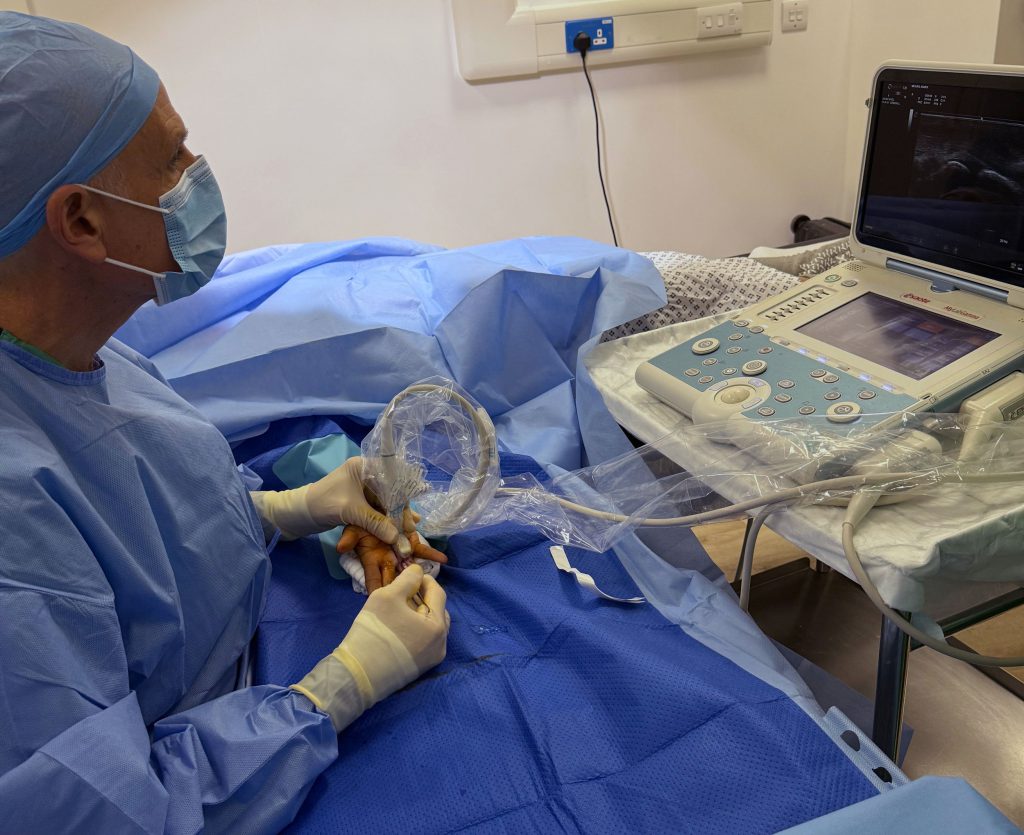
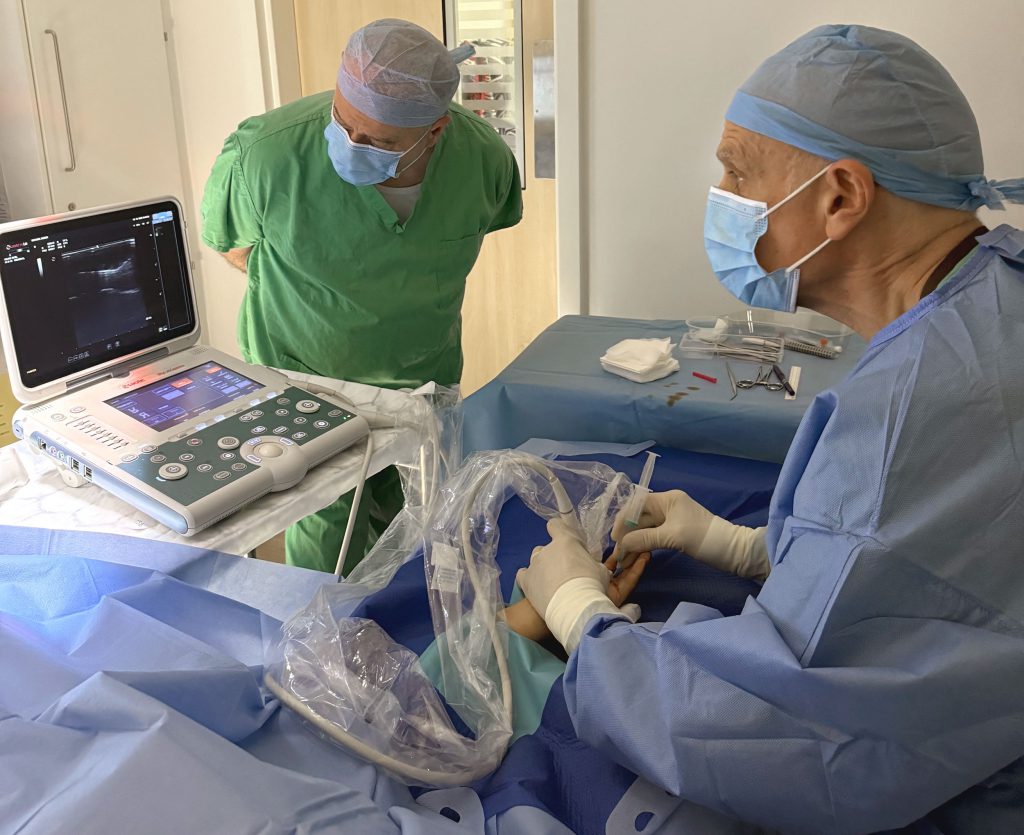
Using a high-resolution ultrasound scanner, I can see the pulley, the tendon, and the nearby nerves and blood vessels throughout the procedure. Through a tiny incision at the base of the finger, just a few millimetres, I pass a fine keyhole knife and release the pulley under direct ultrasound vision.
The outcome is exactly the same as with the open operation, but without the big cut in your palm.
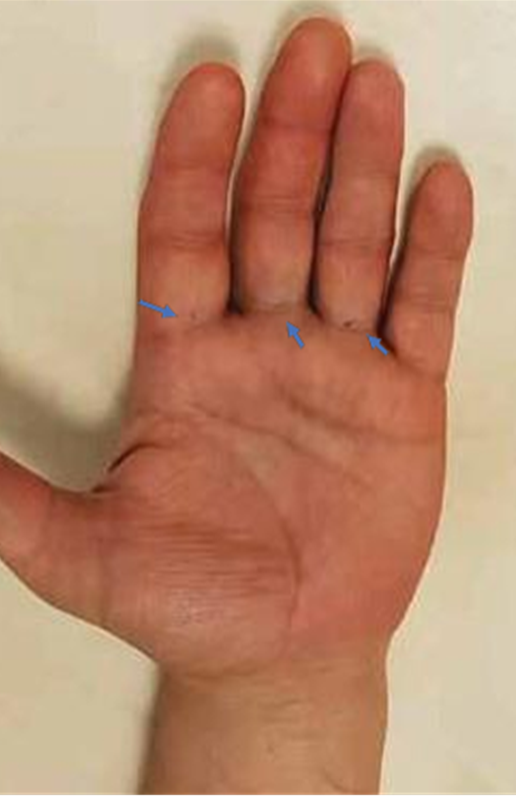
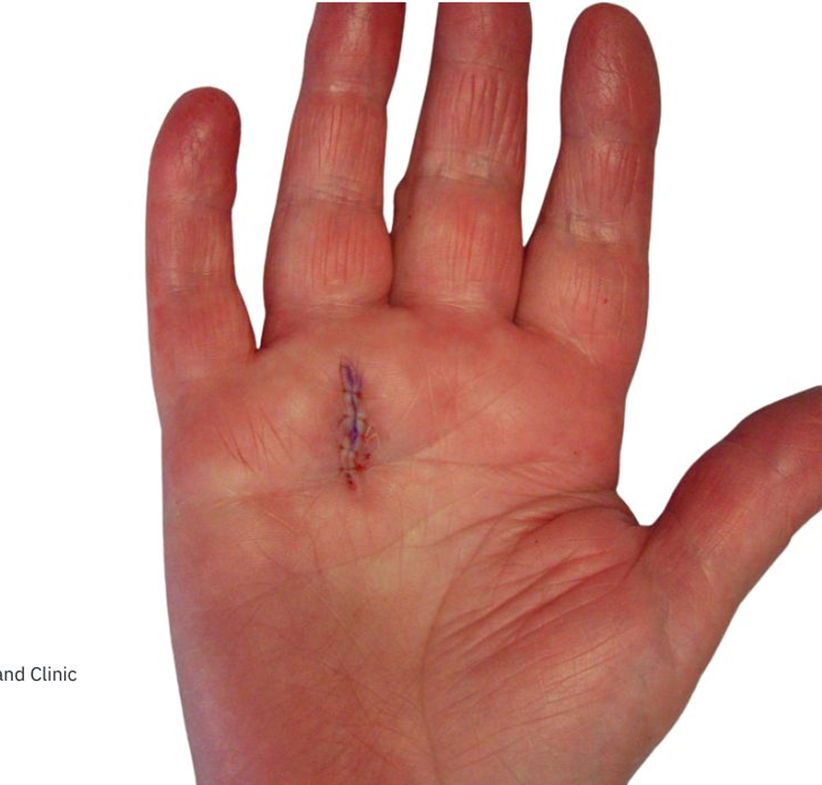
A tiny incision at the base of the finger has far less pain and limitation than a 2cm cut in the palm.
Why Choose Keyhole Release?
| Traditional Open Release | Keyhole Ultrasound-Guided Release | |
|---|---|---|
| Incision | About an inch in the palm | A few millimetres at finger base |
| Stitches | Yes, removed after 1 week | None |
| Anaesthetic | Local or general | Local only |
| Wash and dress normally | About 1 week | Next day |
| Driving | 1–2 weeks | 2–3 days |
| Light activities | Several days | Same day |
| Full grip strength | About 1 month | About 1 month |
| Scar tenderness | Common for several weeks | Minimal |
| Multiple fingers | Possible but longer recovery | Easily done in one session |
| Infection risk | Low | Very low |
Both methods are highly effective. Full power grip takes about a month to return with either approach. But the big advantage of keyhole release is that you haven’t got a painful cut in your palm with all the scar tenderness that brings.
Am I Suitable?
Most patients with trigger finger are suitable for keyhole release. The ultrasound assessment during your consultation will confirm whether this approach is right for you.
Ideal candidates include:
- Patients wanting the fastest possible recovery
- Those with no previous surgery to the affected finger
- Patients whose ultrasound shows favourable anatomy
Some patients, particularly those with previous hand surgery, significant scarring, or unusual anatomy, may be better suited to traditional open release. I will always recommend whichever approach is safest and most appropriate for you.
What to Expect
The local anaesthetic injection is the most uncomfortable part, a brief sting lasting a few seconds. The anaesthetic I use is almost painless to administer and extremely effective.
The procedure itself takes just a few minutes. You will feel some pressure but not pain. Most patients are surprised how quickly it is over, and delighted when they can move the finger freely straight away.
Recovery:
- You may use your hand immediately, as comfort allows
- Light activities the same day
- Wash and dress normally the next day
- Driving usually possible after 2–3 days
- The tiny incision heals within days
Results:
The triggering stops immediately. Most patients walk out moving their finger freely for the first time in months.
You will still have some tenderness and aching afterwards, and full power grip takes about a month to return, much the same as with open surgery. But the big advantage is that you haven’t got a painful cut in your palm with all the scar tenderness that brings.
Treating Multiple Fingers
Because recovery is so quick with the keyhole technique, we can treat several fingers at once if necessary, even fingers on both hands. You will be able to wash and dress the next day, and most patients are back to normal activities within a few days. This saves you facing multiple separate procedures and recoveries.
Aftercare & Recovery Tips
- Move your fingers gently to prevent stiffness.
- Avoid heavy lifting until advised.
- Contact your surgical team if you notice redness, swelling, or increasing pain.
- The bandage can be removed the next morning.
- You may use your hand straight away as pain allows. You can drive at 48 hours.
- You can wash your hand the next day. Put a little plaster on the cut for 72 hours.
Risks and Complications
All procedures carry some risk. With keyhole ultrasound-guided release:
Rare:
- Infection (much lower risk than open surgery because the tiny incision heals so quickly)
- Incomplete release (very rare, if this occurs, a further procedure can complete the release)
- Temporary bruising or mild swelling
- Transient numbness or tingling
Very rare:
- Nerve or blood vessel injury (the real-time ultrasound visualisation makes this extremely unlikely)
Traditional open surgery carries a higher risk of scar tenderness and a longer recovery period.
Frequently Asked Questions
Is keyhole release as effective as open surgery?
Yes. You achieve exactly the same outcome. The pulley is released so the tendon can glide freely. The only difference is how we get there.
Will I need stitches?
No. The incision is so small it heals without sutures.
How soon can I drive?
Most patients can drive after 2–3 days.
When can I wash my hands normally?
The next day.
Can I have more than one finger treated at once?
Yes. Because recovery is so quick, we can treat several fingers, even on both hands, in one session.
Will the triggering come back?
Recurrence after surgical release is rare. The pulley is divided permanently, allowing the tendon to glide freely.
Does it work straight away?
Yes. The finger moves freely immediately after the procedure.
How long until I can grip properly?
Full power grip takes about a month to return, the same as with open surgery. But you will be using your hand for light tasks straight away.
What if I’ve had a steroid injection that didn’t work?
Failed injection is one of the main reasons patients proceed to surgery. The keyhole release will still work well.
Is nerve injury a risk?
The risk is very low. Because I can see the nerves throughout the procedure on ultrasound, I can work around them with precision.
Booking a Consultation
To discuss treatment options for trigger finger or trigger thumb, please contact my secretary to arrange an appointment.