


Shoulder Assessment and Treatment
If you have a shoulder problem, the traditional route to diagnosis and treatment can be frustratingly slow.
- First, you see a consultant for a clinical examination. If an ultrasound scan is needed, and it usually is, you are sent to the imaging department on another day.
- A radiographer performs the scan and writes a report, which is sent back to your consultant.
- You then return for a follow-up appointment to discuss the results.
- If the decision is made to try a cortisone injection, you are sent back to the imaging department yet again for the injection itself.
That is four separate visits, often spread over several weeks, before you have a diagnosis and treatment.

A Better Way
For many years I have been offering my patients a ‘one-stop’ shoulder clinic. Everything that would normally take four visits happens in a single appointment.
You arrive with a shoulder problem. You leave with a diagnosis, a clear explanation of what is wrong, and if appropriate, your treatment already completed.
No waiting for scan appointments. No chasing reports. No coming back again and again.
How It Works
There are three parts to the one-stop appointment:
1. Clinical assessment
I begin with a thorough specialist shoulder assessment and examination, taking a history, measuring your range of movement, strength, and the pattern of your pain. This narrows down the possible causes and the diagnostic ultrasound will help further.
2. Diagnostic ultrasound
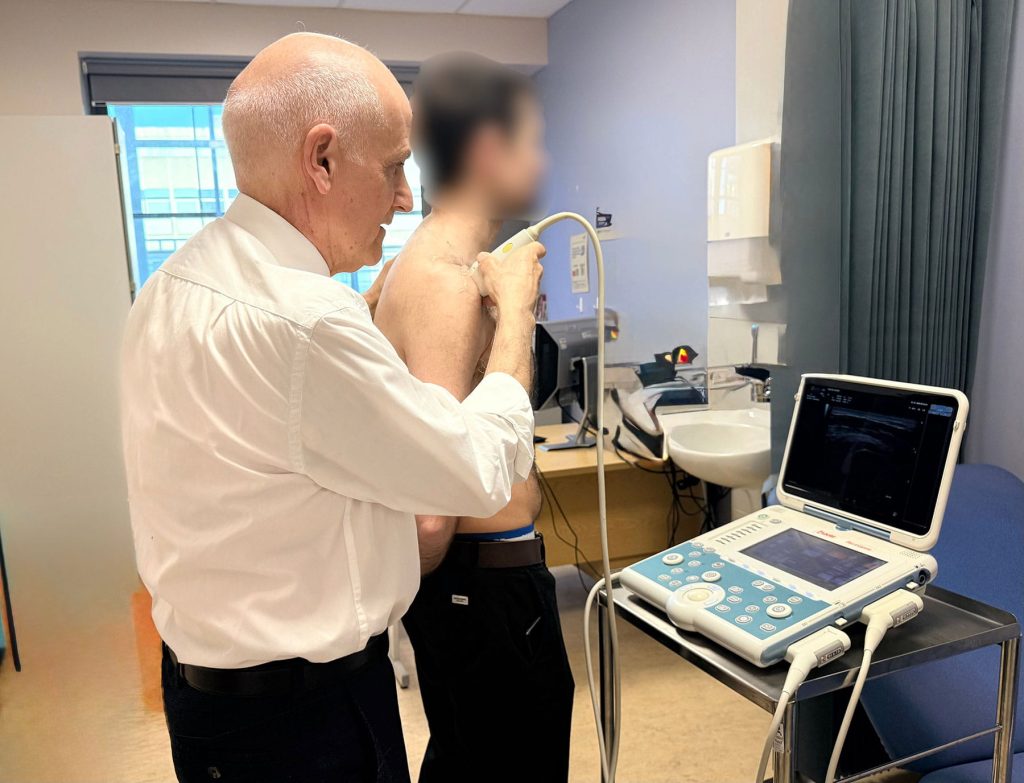
Using a high-resolution ultrasound scanner, similar to the machines used in obstetrics, I scan your shoulder myself, during the same appointment. I can see the rotator cuff tendons, the bursa, the biceps tendon, and the joints in real time.
This is particularly helpful for diagnosing:
- Rotator cuff tears and tendonitis
- Calcific tendonitis
- Biceps tendon inflammation
- Acromioclavicular joint arthritis
- Bursitis
Because I am performing the scan myself, I can correlate exactly what I see on the screen with your symptoms and my clinical findings. There is no waiting for a written report, I can show you what is happening on the screen and explain it there and then.
3. Ultrasound-guided injection
If an injection would help, I can give it during the same appointment, guided by ultrasound so that the medicine goes precisely where it is needed.
Because I can see exactly where the needle is going, I use a finer needle and a smaller volume of medicine than would otherwise be necessary. This makes the injection far more comfortable. And because the medicine is placed accurately, these injections work reliably, they never fail to ‘take’ because they were not quite in the right place.
Standard Pathway vs One-Stop Clinic
| Standard Pathway | One-Stop Clinic |
|---|---|
| Visit 1: Consultant assessment | Visit 1: – Consultant shoulder examination – Diagnostic ultrasound by your consultant – Ultrasound-guided injection if appropriate |
| Visit 2: Ultrasound scan (imaging department, different day) | |
| Visit 3: Follow-up to review ultrasound report | |
| Visit 4: Return to imaging department for guided injection | |
| Total: 4 appointments over several weeks | Total: 1 appointment, usually under an hour |
What Happens at the End of the Appointment?
Before you leave, I will explain all my findings, often using anatomical shoulder models to help you understand exactly what is going on.
You will know:
- What is causing your pain
- The recognised treatments, including physiotherapy, cortisone injections and surgery
- What to expect over the coming weeks
If an injection is appropriate and you are happy to proceed, that can be given there and then. Many patients feel significant relief within days.
You will leave knowing exactly what is wrong and what can be done about it.
Is the Injection Painful?
This is the question patients ask most often, and understandably so.
With ultrasound guidance, because I can see exactly where the medicine is going, I use a much finer needle and a smaller volume than a ‘blind’ injection would require. Most patients say it feels no worse than a flu jab.
After the injection, many patients say, ‘Was that it?’
There may be some aching later that day or the next, but this is usually mild. The cortisone typically takes a few days to work, and most patients notice significant improvement within a week.
What Conditions Can Be Treated This Way?
The one-stop clinic is suitable for most common shoulder problems, including:
- Rotator cuff tears and tendonitis
- Impingement syndrome
- Frozen shoulder
- Calcific tendonitis
- Biceps tendonitis
- Acromioclavicular joint arthritis and pain
- Bursitis
For some patients, an injection provides lasting relief – sometimes permanently. For others, it is a useful step that reduces pain while we plan further treatment. Either way, you will leave your appointment with a clear diagnosis and a plan.
What If I Need Surgery?
Not every shoulder problem can be solved with an injection. If surgery is the right answer, I will explain this clearly and discuss your options. The one-stop assessment gives me all the information I need to advise you properly, so even if you do need an operation, you will leave knowing exactly what is wrong and what we are going to do about it.
Why Do I Perform the Ultrasound Myself?
Many consultants rely on scans performed by radiographers in the imaging department. These are reported in writing, and the consultant reviews the report later.
I prefer to scan the shoulder myself for several reasons:
- I can examine you clinically and then immediately see what the ultrasound shows, correlating symptoms, examination findings and imaging in real time
- I can look specifically at the areas that concern me, rather than relying on a standard protocol
- I can show you what I am seeing and explain it on the spot
- If an injection is appropriate, I can give it there and then with perfect accuracy
This approach has served my patients well for many years. It is quicker, more convenient, and,I believe, leads to better decisions.
Frequently Asked Questions
How long does the appointment take?
Usually around 30–45 minutes, depending on complexity. If an injection is given, you can leave immediately afterwards.
Do I need to prepare for the ultrasound?
No special preparation is needed. Wear clothing that allows easy access to your shoulder.
Can I drive home afterwards?
Yes. The injection does not affect your ability to drive.
How quickly will the injection work?
Most patients notice improvement within a few days to a week. The cortisone reduces inflammation gradually.
How long does the benefit last?
This varies. Some patients get permanent relief from a single injection. Others find symptoms return after several months. If needed, injections can be repeated, though if you are requiring frequent injections, we would discuss other options including surgery.
What if the injection does not work?
If an injection does not help, that itself is useful information. It tells us more about what is going on. We would then discuss other treatment options, which might include physiotherapy, further investigation, or surgery.
Is cortisone safe?
Cortisone injections are very safe when used appropriately. Occasional injections into a joint or bursa do not cause the side effects associated with long-term oral steroids. I would not recommend repeated frequent injections into the same area, but one or two injections spaced several months apart are not a concern.
Can I have the one-stop clinic if I have already had a scan elsewhere?
Yes. I am happy to review previous imaging, but I may still want to scan you myself, as I often pick up findings that change my understanding of the problem.
Booking an Appointment
To book a one-stop shoulder assessment, please contact my secretary to arrange a consultation.